
In the technology world, we obsess over system architecture. We define protocols, strictly review our variables, and document our dependencies. We do this because we know that undefined systems lead to entropy, conflict, and eventual failure.
Yet, when it comes to the most complex component of our stack—the humans—we often leave the architecture to chance.
This is a failure of Human Engineering.
As a manager, your primary role is not just to supervise tasks, but to engineer the environment in which your team operates. You must understand your team's cognitive limits, their emotional drivers, and their communication bandwidth. Just as you wouldn't pour a foundation without a blueprint, you shouldn't launch a team without a Team Agreement.
A Team Agreement is the core artifact of Human Engineering. It is the documentation for your people. It bridges the gap between rigid company policy and the messy reality of human interaction, transforming "assumed expectations" into explicit, engineered protocols.
Here is how to architect one that aligns everyone from early-career engineers to senior leadership.
1. The Schema: Architecting the Agreement
A robust Team Agreement covers the "how" of collaboration. To create a comprehensive operating system for your team, you should workshop these five key categories:
- Hybrid Protocols:
- The "Why": Define the purpose of in-person time versus remote time.
- The Rules: Set the specific "Anchor Day" for high-bandwidth collaboration and establish if there are "Focus Days" where remote work is protected.
- Communication Architecture:
- Channels: What belongs in instant messaging (e.g., Slack/Teams) vs. Email vs. Project Management tools (e.g., Jira/Linear)?
- SLAs: Define "Urgent." (e.g., "DM response expected within 2 hours; Email is 24 hours").
- Meeting Structure:
- The "No-Meeting" Zones: Reserve blocks for deep work flow states.
- Etiquette: Agree on "cameras on/off" norms and the requirement for agendas (no agenda, no attendance).
- Engineering Standards:
- Quality: How do we handle PR reviews? What is our definition of "Done"?
- Mentorship: Expectations around pair programming or "office hours" for support. How to get support? when to reach out about being stuck on a problem.
- Conflict & Feedback:
- Protocol: How do we disagree? (e.g., "Debate the code, not the coder").
- Safety: How do we raise blockers without fear of blame?

2. The Pitch: Why Human Engineering Matters
Before you schedule the workshop, you must sell the value. A Team Agreement isn't bureaucratic overhead; it is a performance optimization. Regardless of role or seniority, the core value proposition is predictability and clarity.
For the Individual Contributor, this agreement is a shield. It protects "Deep Work" time by setting clear boundaries on interruptions and meetings. It replaces anxiety ("Did I reply fast enough?") with clarity ("I have 2 hours per the SLA").
For Management, this agreement is an accelerator. It removes the need to micromanage behavior because the team has self-policed the rules. It creates consistency in code quality and reduces the friction of onboarding new hires.
When you pitch this to your team, focus on three universal benefits:
- Reduced Cognitive Load: Less guessing about what is expected means more brainpower for coding.
- Psychological Safety: Clear conflict protocols make it safer to raise issues early.
- Scalable Autonomy: You can only give a team freedom if the guardrails are clearly defined.
3. The Facilitation Framework: Manage, Present, Follow-up
Once you have buy-in, the method of facilitation matters more than the meeting itself.
Phase 1: Pre-Game (Async Preparation)
- The Context: Never walk into the room cold. Send a brief 1-2 days before: "We are meeting to define our Team Agreement. Please come ready with your top preferences for [Category X] and your non-negotiables."
- The Data: Bring objective data if possible (e.g., "Our sprint velocity drops on Tuesdays—why?").
- The Guardrails: Be transparent about constraints. If "3 days in office" is a firm corporate mandate, state it upfront to focus energy on variables the team can control, rather than debating fixed policies.
Phase 2: The Session (Sync Execution)
- The Opening: Frame the problem as a design challenge: "We are designing our team's user experience."
- The Activity: Avoid open debate which favors the loudest voices. Use Dot Voting or a Decision Matrix.
- Example: If discussing "Deep Work" blocks, present three specific options on the whiteboard:
- No meetings on Friday afternoons.
- No meetings before 11:00 AM daily.
- A full "Maker Day" on Wednesdays.Have the team place sticky notes (dots) on their preferred option. This visualizes consensus instantly without an hour-long argument.
- The "Disagree and Commit": You aim for consensus but settle for alignment. Acknowledge outliers, but steer the group toward decisions that benefit collective velocity.
Phase 3: The Aftermath (Follow-up)
- Codify It: Don't let the decision die in the meeting notes. Create a living document (Confluence, Notion, or a README in your repo).
- The Trial Period: Commit to a specific timeline. "We will try these communication norms for 4 weeks." This lowers the stakes and reduces resistance to change.
- The Retro: Schedule a review meeting. If a rule isn't working, deprecate it.
- Live Document: A static document is a dead document. Review this agreement quarterly. The first few iterations may require detailed debate, but eventually, this becomes a 5-minute maintenance check.
4. Coaching Questions to Spark Debate
If your team is silent during the drafting session, use these coaching prompts to uncover hidden friction:
- For RTO: "What is the one task you can only do well in person? Conversely, what task is impossible to do in the office?"
- For Meetings: "If we deleted all recurring meetings next week, which one would you actually miss?"
- For Communication: "What is the most stressful notification you receive? Why?"
- For Conflict: "When was the last time we disagreed well? What did that look like?"
- For Standards: "What is a 'hidden rule' on this team that a new hire would only learn by making a mistake?"
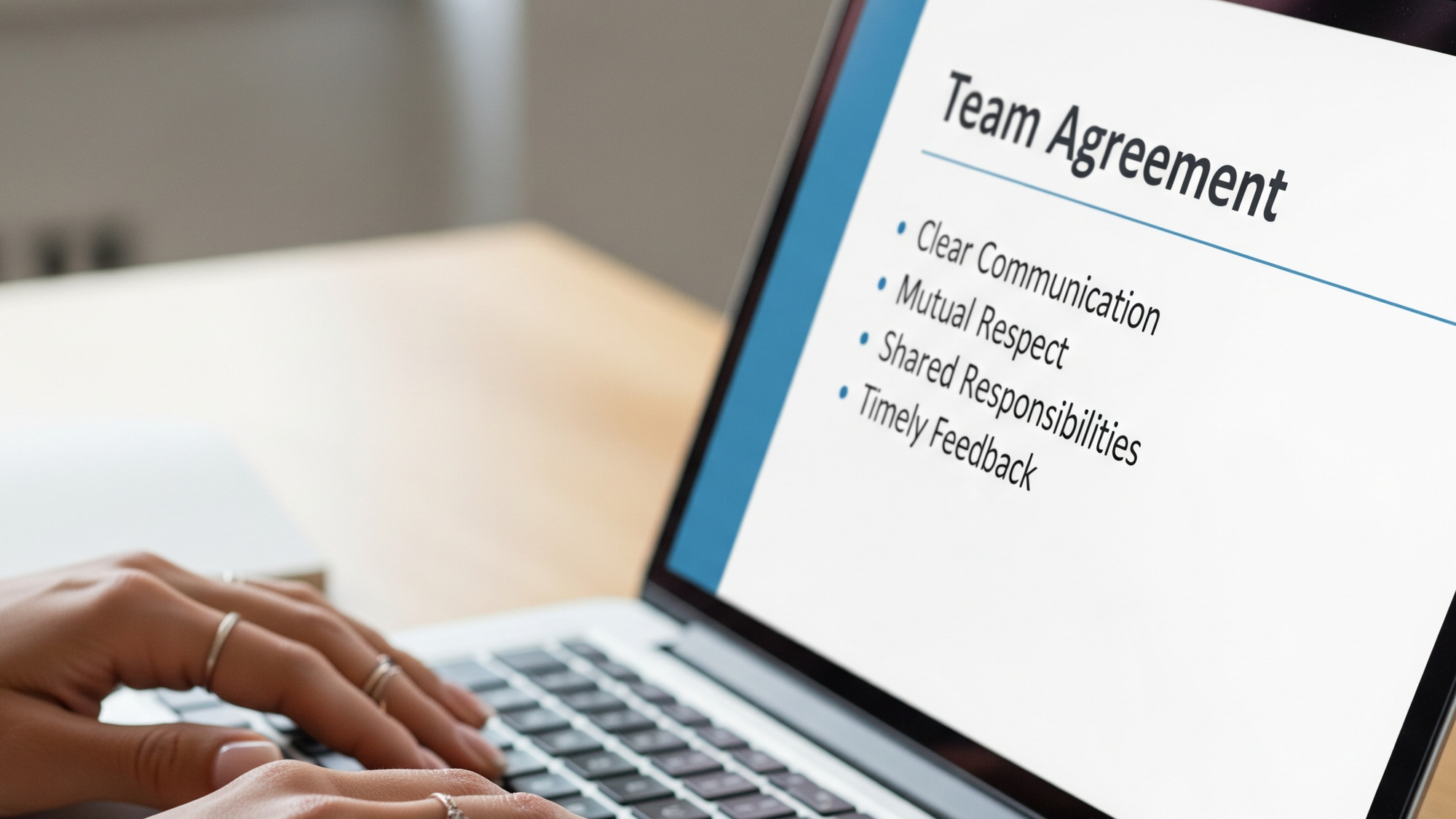
5. Appendix: Team Agreement Template & Sample
To put it in motion I have created a template you can use as a starting point for your team.
Download it: [Template: The Team Agreement]
See it in action bellow:
Team Alpha Agreement
Last Updated: [Date] | Review Date: [Date + 6 Weeks]
1. Logistics & Hybrid Work
- Anchor Days: We are in the office Tuesdays and Thursdays.
- In-Person Purpose: These days are for whiteboarding, sprint planning, and social connection. No "headphones-on" coding for >2 hours.
Core Hours: We are all available online from 10:00 AM to 3:00 PM EST.
2. Communication Protocols
- Instant Message (e.g. Slack): Asynchronous by default. No expectation of immediate reply unless tagged @urgent.
- Email: Used for external comms and decisions that need a paper trail. 24h response time.
- Status: Update status daily (e.g., "Focus Time ⛔️", "In a Meeting 📅").
3. Meeting Structure
- Golden Rule: No Agenda = No Attendance.
- Deep Work: No internal meetings on Fridays after 1:00 PM.
- Lateness: If you are >5 mins late without notice, we start without you.
4. Code & Quality
- PR Reviews: Must be reviewed within 24 hours. The reviewer is responsible for unblocking the author.
- Definition of Done: Code merged, tests passed, docs updated, feature flag toggle tested.
5. How We Disagree
- We attack the problem, we write it down and discuss it as a team.
- If a chat debate goes over 10 messages, we move to a 5-minute call.



Comments